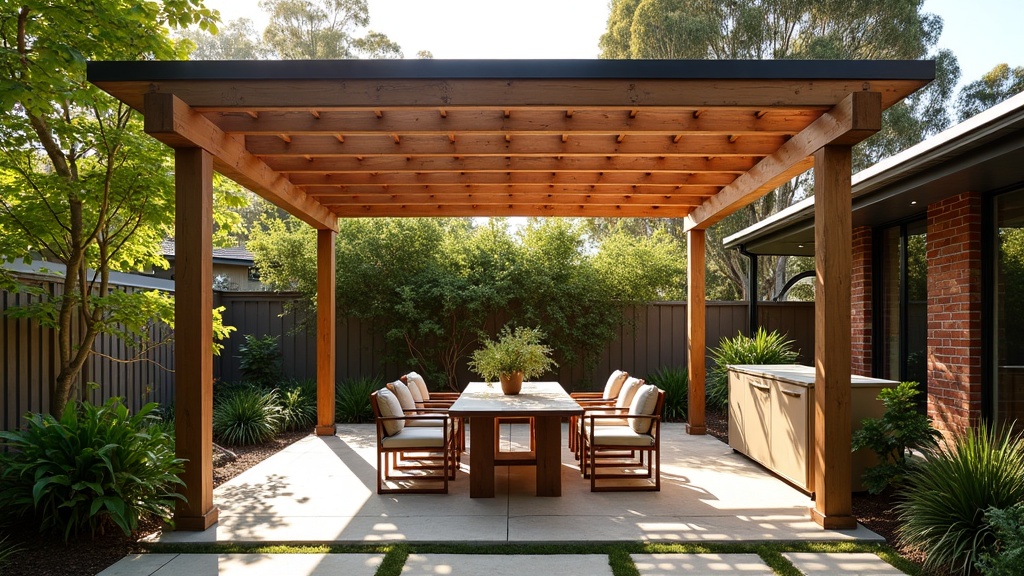
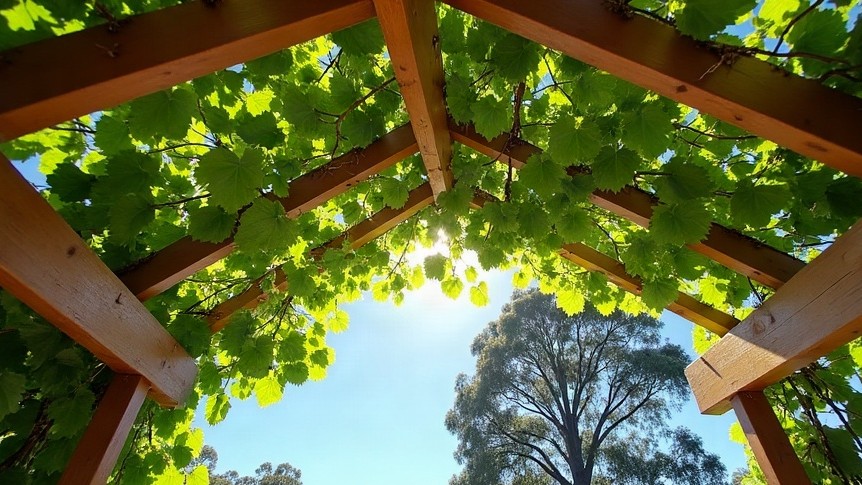
If you want a pergola that shades you in January and lets the sun back in by June, plant a deciduous climber. An ornamental grape or a wisteria will cover an open-rafter pergola in a few seasons, drop its leaves in autumn, and leave a bare frame for the winter light to come through. Evergreens give you shade all year, which can leave a living area under the pergola dark through winter.
Why deciduous suits a pergola off a living area
The Australian Government’s YourHome guide lists pergolas with deciduous vines as a shading option for living areas facing north-east and north-west, because they allow winter solar heating. It lists them for east and west facing living areas too. That is the whole trick. Summer sun sits high and the leaves block it. Winter sun sits low and comes in under and through the bare canes.
The same guide also suggests climber-covered lattice and vertical screens for low-angle sun on east and west sides.
Before you plant, have a think about which way the pergola faces. Our pergola design and placement guide covers orientation in more detail.
Climbers we’d put on a Melbourne pergola
These are the ones that suit a timber or steel frame, handle Melbourne’s dry summers and cold snaps, and behave themselves with regular pruning.
- Ornamental or fruiting grape: fast, big leaves, good autumn colour, and bare by winter. Fruiting varieties drop grapes on the paving, so put an ornamental one over an outdoor dining table.
- Wisteria: the classic spring flower show over a pergola. It is heavy and strong once it matures, so only put it on a solid frame, and keep it off gutters and downpipes.
- Climbing roses: deciduous, flowers through the warmer months, and easy to train along beams. They need tying in, and the thorns mean you keep them away from where people walk.
- Kiwifruit: a vigorous deciduous vine with big soft leaves. Most varieties need a male and female plant to fruit, so check the label if you want the fruit.
- Star jasmine: evergreen, scented and well mannered. Good on a west-facing screen or a side post, but not the one for a north roof if you want winter sun.
Got a polycarbonate or louvred roof? Climbers and a solid roof don’t mix well. The leaves and debris sit on top, the stems push into the louvre gear, and you lose the point of the roof. Our pergola roofing options article compares open rafters with covered roofs if you’re still deciding.
The ones to leave out
Some climbers spread well beyond the backyard. Whitehorse City Council’s list of weed climbers and scramblers includes English ivy (Hedera helix) and Japanese honeysuckle (Lonicera japonica), both rated very high risk, and morning glory (Ipomoea indica), rated high risk.
The council describes Japanese honeysuckle as reaching up to 8 metres and morning glory as a very vigorous climber that can smother trees and shrubs, spread by seed and dumped garden waste. Cape ivy and moth vine are on the same list. If something is on your council’s weed list, don’t plant it, however quickly it would cover the pergola.
Get the frame ready before the plant goes in
A climber is a load on the structure, and that load grows every year. A mature wisteria trunk can get thick enough to bend a light batten or spread a joint. Here’s what we check before planting.
- Posts and beams: make sure they’re sized for the extra weight and wind catch, not just the roof. If in doubt, ask whoever built it.
- Timber condition: stain or oil the timber before the vine covers it, because you won’t get a brush in there later. Our guide to choosing pergola timber covers which species hold up.
- Support wires: run stainless wire or a lattice panel up the post so the stems have something to grab. Don’t let the vine wind directly around a thin rafter.
- Distance from the house: keep the planting hole off the slab edge and away from stormwater pits, and plan to keep growth out of roof gutters.
Pruning: the job that decides how it turns out
An untrained climber turns into a tangle on top with bare legs underneath. Pruning is what keeps it as a flat, even canopy.
For the first couple of years, pick one or two strong leaders and tie them up the post. Cut out the rest. Once they reach the beams, train them along the top and let side shoots fill in.
After that, a winter prune on grapes, roses and kiwifruit keeps the frame clean and lets more sun through when you want it. Wisteria gets two cuts: shorten the long whippy summer growth after flowering, then tidy back to a few buds in winter. It sounds fussy, but it stops the vine growing into the gutter or pushing under the roof sheets.
Shade now while the vine grows
A new climber won’t shade much in its first summer. A lot of people run a shade sail or a temporary shade cloth over the rafters for the first season or two, then pull it off once the canopy has filled. Our article on pergola shade options runs through sails, cloth and retractable canopies if you need cover straight away.
Plant in spring or autumn, water it well through the first summer, and give it time.
Sources
- Australian Government, YourHome, Shading, retrieved 2026-10-14.
- Whitehorse City Council, Weed climbers and scramblers of Whitehorse, retrieved 2026-10-14.