Most people asking about pergola shade have worked out that the frame alone does not do much. Bare rafters look good and throw stripes across the table, and that is about it. The real question is whether you want shade that is permanent, shade you adjust through the day, or shade you pack away when winter comes.
Worth separating from the roofing question. Roofing keeps rain off, shade controls sun. Some products do both, most do one, and money gets wasted buying the wrong one for the job you actually had.
Work out where your sun comes from first
Before anyone quotes you, stand in the space at 2pm in February, then at midday in July. The summer sun here comes in high and hot, mostly overhead and from the west late in the day. The winter sun sits low in the north, and you almost certainly want it.
This is why fixed shade disappoints people. It kills the February heat beautifully, then leaves you a cold dark slab from May to August that nobody uses. Off a north facing living room, it makes that room darker year round too.
Adjustable louvred roofs
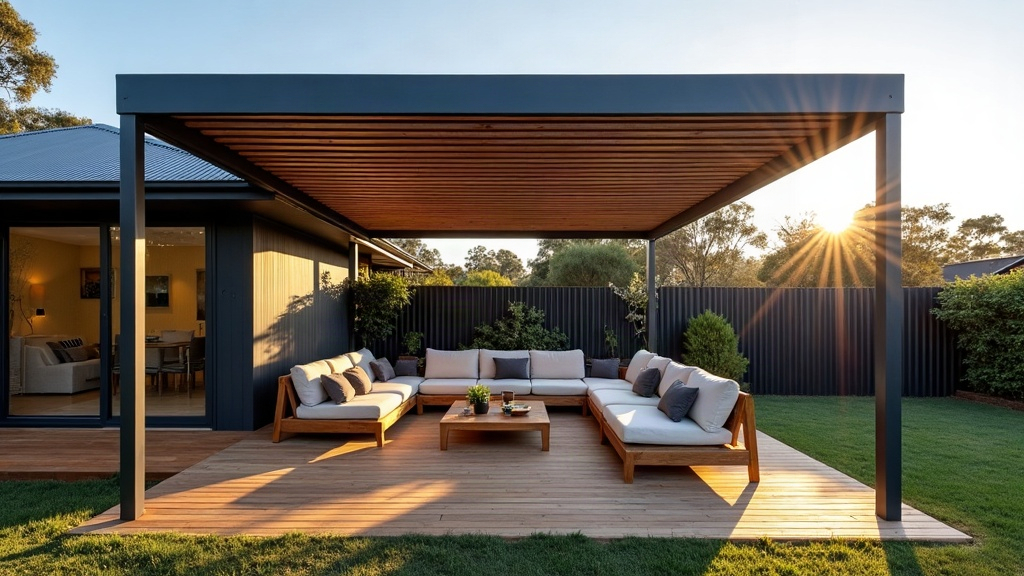
Opening louvres are the premium answer and they earn it. Aluminium blades on a manual or motorised drive, tilting from fully open to closed. Open them for winter sun, angle them against the afternoon glare, close them when the weather turns.
- Year round control: sun in July and full shade in February without touching the structure.
- Rain performance: a good system seals well enough to sit under during a shower, provided the run off has somewhere to go.
- Structure requirements: blades and motors are heavy, so posts and beams often need upsizing, and retrofitting onto existing timber is not always possible.
- Maintenance: little on the blades, but motors, seals and remotes eventually need service.
It is the dearest option by a clear margin, usually several times a shade sail over the same span. If the pergola is the main outdoor room of the house, it is also the one that gets used most.
Shade sails
Sails are the cheapest real shade you can put over a pergola, and for plenty of backyards they are the right call. Knitted shade cloth blocks a stated percentage of UV and the manufacturer publishes that figure per fabric, so ask for that figure.
Fixings are where people get caught out. A sail is a big sheet catching wind, and all of that load goes into whatever you tied it to. Pergola rafters are sized to hold a roof up, not to resist a sail pulling sideways in a southerly. A good installer will tell you what the fixing points need to be and will tension it with turnbuckles.
Limitations: most shade cloth is not waterproof, so a shower still comes through, just slower and in bigger drops. Sails sag and need retensioning, fabric fades, and if you want winter light back you are taking it down and storing it.
Retractable canopies and folding arm awnings
These sit in the middle on price and behaviour. A canopy runs on a track between the rafters and folds back like a concertina. A folding arm awning cantilevers off the house wall with no posts at all.
You get shade when you want it, open sky when you do not, and no seasonal dismantling. The trade off is that fabric on a mechanism is the least forgiving thing you can put outdoors. Units carry a wind rating and the manufacturer will tell you to retract above it, which means somebody has to actually do it, or you pay for a wind sensor.
Awnings need a wall that can carry the load. Brick veneer is usually fine with the right fixings into structure, but that is the installer’s call on site.
The two alternatives nobody quotes on
Polycarbonate sheeting is a roof, not shade. It keeps rain off, and tinted or opal grades cut a fair bit of glare and heat, but it is permanent and loud in heavy rain. If rain cover comes first, that is a roofing conversation.
Planting is the slow option that genuinely works. A deciduous vine on a wire frame gives dense summer shade and drops its leaves for winter light, which is the behaviour you are paying a louvre motor to replicate. It takes a few seasons to fill in and gets into anything it can reach. On a timber pergola in a sheltered yard it is hard to beat for the money.
Wind and fixings are where the money should go
Whatever you choose, the connection fails before the product does. Anything catching wind pushes that load into the posts, the footings and, on an attached structure, the house wall. Ask what wind classification the installer has designed for at your site, and get the answer in writing. A supplier who cannot answer that is guessing.
On permits, adding shade to an existing pergola often triggers nothing, but that depends on the structure, its size, where it sits on the block and your council. Check with your local council and the Victorian Building Authority for your situation rather than relying on what a neighbour got away with.
Can you sit under a shade sail in the rain?
Not comfortably. Standard knitted shade cloth is permeable, so water comes through. Waterproof PVC sails exist, but they need more fall built in and a planned run off point, or water pools and the sail stretches.
How to choose without overthinking it
Main outdoor room, and you want the winter sun back: adjustable louvres. Usable shade this summer for the least money, and you can live without rain cover: a properly engineered shade sail. Flexibility without a seasonal ritual: a retractable canopy, as long as somebody closes it when the wind gets up. Patient, with a timber frame already standing: plant a vine and let it do the work. Still choosing the structure itself? Start with our Melbourne outdoor structures guide.