If you want a pergola you actually sit under in July, sort the power out before the posts go in the ground. Heating, lighting and fans are all easy while the structure is open and the trenching is cheap. Once the paving is down and the rafters are finished, every one of those jobs gets harder and dearer. That is the whole lesson in one sentence, and it is the bit most people skip.
Work out how you will use it, then size the power
A pergola used for a barbecue twice a summer needs almost nothing. One you want to eat under in winter, with a heater running, lights on and a fridge in the corner, is a different beast. Add up what will run at once. A couple of radiant heaters will pull a serious load on their own, and if you hang them off an existing outdoor point that already runs the pool pump, you will be resetting the switchboard all night.
Have the conversation with your electrician early. Ask whether the switchboard has spare capacity, because if it does not, that is a cost you want to know about now rather than after the slab is poured.
Heating: what works under an open roof
Melbourne’s problem is not brutal cold, it is a damp seven or eight degrees with a breeze through it. Under an open or slatted roof, warm air simply rises and leaves. That rules out anything that works by heating the air. If you have not settled on a covering yet, the pergola roofing options you pick will change how much heat stays put.
Radiant electric strip heaters
These warm people and surfaces directly rather than warming the air, which is exactly what you want outdoors. They mount to the rafters or a beam, they are quiet, and there is no fuel to store. The catch is that they only heat what they are pointed at, so placement matters more than wattage. Aim them at where people actually sit, not at the middle of the paving.
Gas patio heaters
Gas puts out more heat for the money and does not need a new circuit, which is why cafes use it. The trade offs are bottle storage, refills, and the fact that they take up floor space. Fixed gas appliances are a licensed gasfitter’s job, not a weekend project.
One safety point worth being blunt about: outdoor gas heaters are designed for open air. If you have progressively closed your pergola in with cafe blinds on every side, you no longer have an open space, and burning gas in it becomes a carbon monoxide risk. Closing a structure in can also shift it into verandah or patio territory, which matters for approvals as well as for heating. Read the appliance instructions, and if you have enclosed the area, get a licensed gasfitter to assess it properly.
What tends to disappoint
- Plug in fan heaters: they heat air, and the air blows away.
- Undersized wall units: a single small heater on a five metre span will warm one chair and nothing else.
- Fire pits under a timber roof: lovely idea, poor idea structurally, and smoke has nowhere to go.
Lighting: three layers, not one floodlight
The most common mistake is a single bright fitting in the centre of the pergola. It flattens everything and puts glare straight in your eyes. Think in layers instead.
- Ambient: low level general light, often strip or downlights tucked into the rafters or beams.
- Task: brighter, aimed light over the barbecue and the serving bench, where you need to see what you are doing.
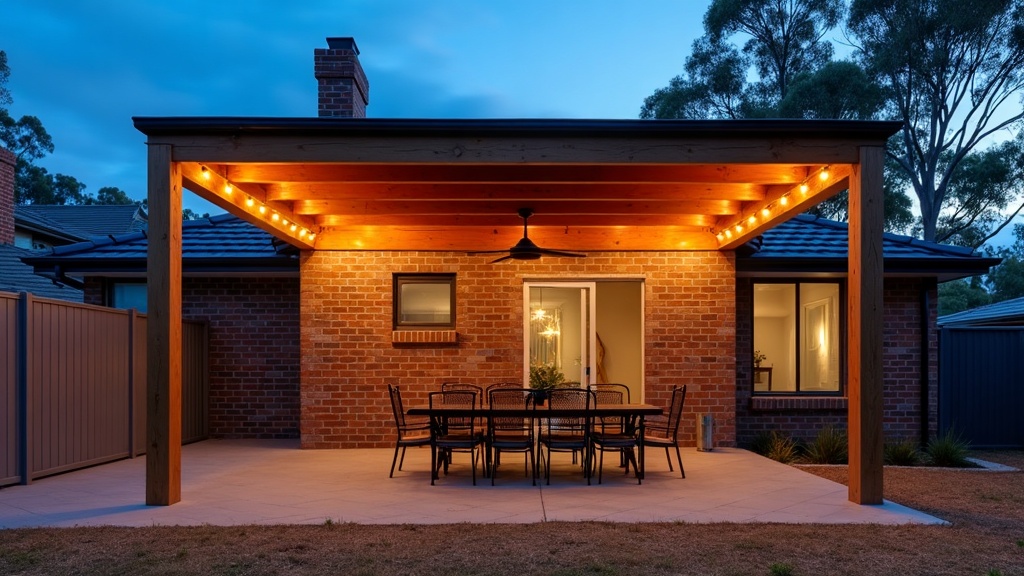
- Feature: uplights on posts or a tree, or festoon strung along the rafters, which is what actually makes the space feel good at night.
Put them on separate switches. Being able to run just the feature layer on a quiet evening is the difference between a space you use and one you flick the lights on in and then go back inside. Everything you install outdoors needs to be rated for the exposure it will get, and the fittings are marked with an IP rating so you can check. A fitting under a solid roof, well back from the edge, has an easier life than one on an exposed post that copes with driving rain.
Fans earn their keep
An outdoor rated ceiling fan is the cheapest comfort upgrade a covered pergola can get, and it does two jobs. In summer it moves air across your skin so the space feels cooler without any refrigeration. In autumn it keeps mozzies from settling. You need enough clearance under the rafters to mount one safely, which is another reason to make the call before the roof is framed rather than after.
Where the DIY stops
This is not a grey area in Victoria. Electrical installation work must be carried out by a licensed or registered electrical worker, and Energy Safe Victoria is the regulator that oversees it. That covers new circuits, new outlets, hardwired heaters, hardwired lighting and fans. Your electrician issues a Certificate of Electrical Safety for the work. Keep it, because it is the paperwork that shows the job was done properly if you ever sell or make an insurance claim. Gas work sits under the same regulator and needs a licensed gasfitter.
What you can do yourself is the plug in end of things: a festoon set on an existing outdoor socket, portable lamps, a freestanding bottle heater used per its instructions.
A sensible order of works
Decide how the space gets used, then have your electrician mark up cable runs and fitting positions on the pergola design before it is finalised. Do the trenching and rough in while the ground is open and the frame is exposed. Frame and roof. Then fit off the lights, fans and heaters, and pave last. That order costs a little planning and saves you cutting into finished work later, which is where the real money goes.