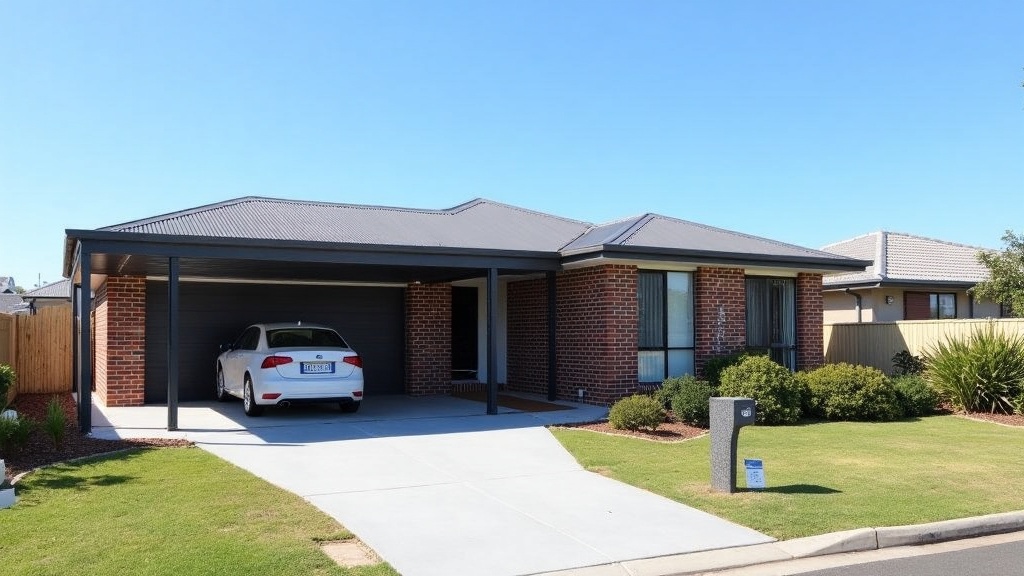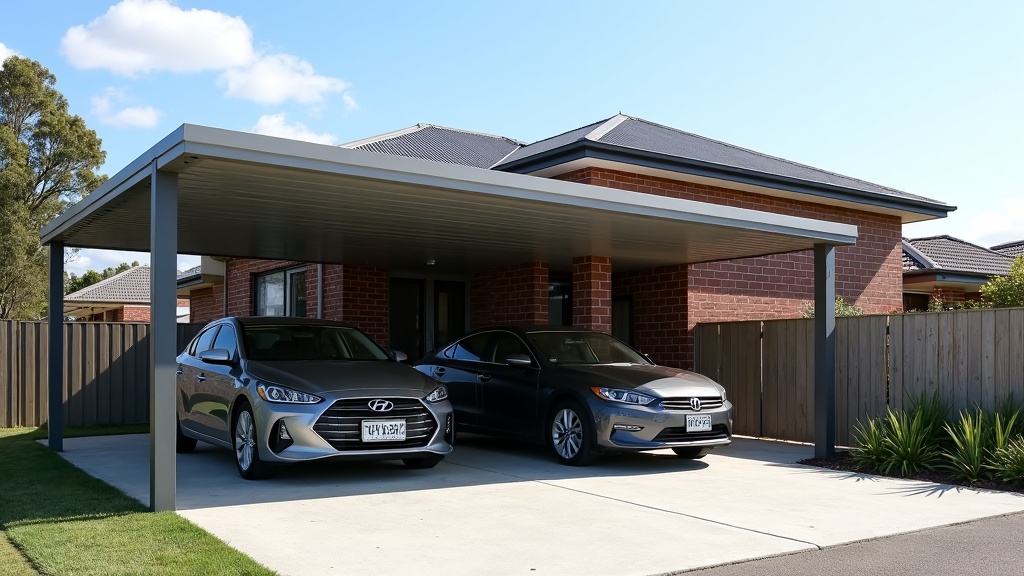
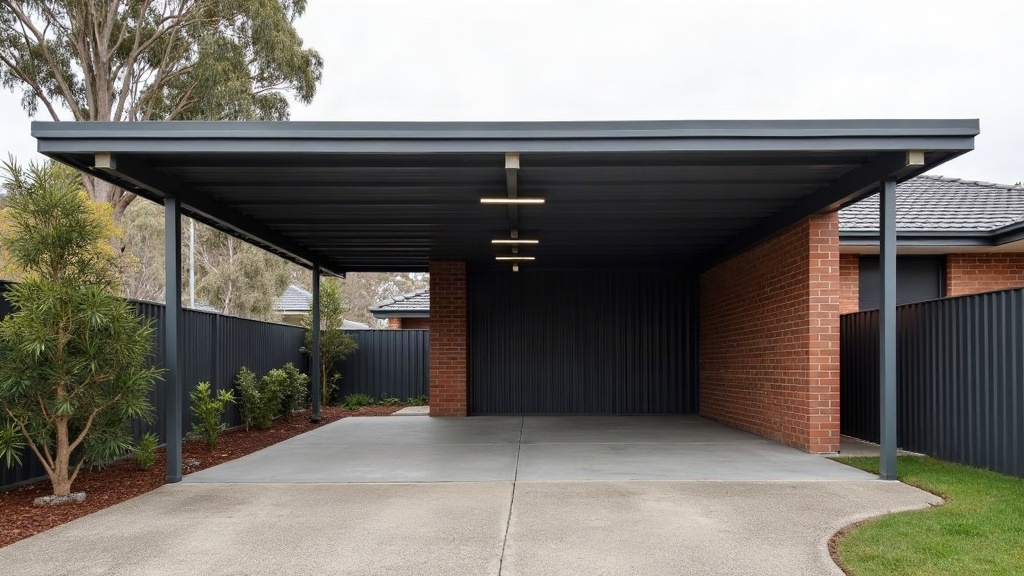
Stand under three carports on a Melbourne afternoon and they feel nothing alike. One is bare steel overhead, one lets the daylight through, and one has an insulated core with a finished ceiling underneath. That’s steel sheet, polycarbonate and insulated panel, and picking between them comes down to four things: how much light you want underneath, how much heat and noise you’ll put up with, how flat the roof is, and what the frame is made of.
If you’re still deciding on the frame itself, our steel vs timber carport guide covers that first.
Is steel sheet still the best all-rounder?
For most Melbourne carports, yes. Single-skin Colorbond or Zincalume sheet is the everyday option. The trade-offs are heat radiating down on a still summer day and noise in heavy rain.
The profile matters more than people expect, because it sets how flat you can go. Lysaght lists a minimum roof slope of 5° for CUSTOM ORB, the classic corrugated look, and 2° for TRIMDEK. Lysaght’s low-pitch guide says KLIP-LOK can go as low as 1° in 0.48 BMT steel and 2° in 0.42 BMT. So if your carport has to tuck under an eave or a gutter with very little fall, corrugated may not be an option at all. Ask which profile is going on before you sign off on the pitch.
One thing that catches out timber carports: steel and some timbers don’t get along. Lysaght’s metal and timber compatibility bulletin lists green or some chemically treated timber, like CCA or tanalith treatments, among the materials coated steel shouldn’t contact, and it covers run-off as well as direct contact. On a treated pine frame, make sure your builder separates the sheet from the timber the way the manufacturer specifies.
When does polycarbonate make sense?
When the space under the roof gets used for more than parking. If the carport doubles as a covered spot for the kids’ bikes, a barbecue or a Saturday tinker, a steel roof makes it gloomy. Polycarbonate lets the light through and keeps the rain off.
It does need a bit more care in the design. Laserlite’s installation guide says the roof pitch should be at least 5°, which it describes as 88mm of rise per lineal metre, and that the UV-protected side has to face the sun. It also says any failure of the sheet caused by fixings other than Laserlite-branded ones voids the warranty, so check what’s going into the roof. The same guide warns about patio heaters under polycarbonate sheeting, so if the plan includes a heater, read that section before you buy.
Expect polycarbonate to show dirt and leaf litter more than steel does, simply because you can see through it. Laserlite also makes heat-reflective sheets, and they’re worth a look on a west-facing carport.
Are insulated panels worth the extra spend?
They earn their keep on attached carports, especially ones you can see from a living area or walk under every day. An insulated panel is a sandwich: a steel top sheet, an insulating core and a finished ceiling underneath, all in one piece.
Bondor describes its SolarSpan panel as a Colorbond steel roof layer with an EPS-FR insulation core and a pre-finished Colorbond ceiling underside. It lists patios and carports among its applications and offers thicknesses from 50mm to 200mm. Bondor also says the panel offers high thermal efficiency and does away with purlins, beams, sarking, separate insulation and plasterboard. In plain terms, you get a cooler roof with a finished ceiling underneath.
The catch is cost: insulated panel costs more per square metre than single-skin steel. Our carport cost guide walks through why roofing choice moves the price so much.
Repaint or re-sheet an old steel roof?
Plenty of Melbourne carports have a roof that’s faded and chalky but otherwise sound. If the sheets aren’t rusted through, holed or sagging between purlins, a proper repaint can bring them back without pulling the roof off. If you’ve got rust holes, lifted fixings or sheets that flex when you lean a ladder on them, it’s time to re-sheet.
The paint job lives or dies on preparation. Barton’s Painting and Decorating, a South East Queensland painting business, sets out its approach on its roof painting page: it paints Colorbond roofs, assesses each roof’s condition before painting, starts every job with a high-pressure wash, and uses coatings formulated for metal roofing.
A quick way to choose
- Freestanding carport, mostly for parking: steel sheet in a profile that suits your pitch.
- Carport that doubles as an outdoor area: polycarbonate, pitched at least 5° with the UV side up.
- Attached carport next to living areas: insulated panel.
- Existing steel roof that’s faded but sound: repaint before you replace.
If you’re still weighing up the structure itself, start with the types of carport that suit Melbourne blocks, and if you’re thinking of closing yours in down the track, read up on enclosing a carport before you lock in a roof.